Don't force it
— why our kids are calmer on the golf course than we are
At the last prize ceremony, names get called out one after another, and with every child the same picture plays out: parents and friends, phones in the air. Then Nikita gets called up as the winner. My phone stays where it is.
Nikita looks over at me in that moment. In his eyes I feel deep gratitude for so much we've been through together, on the golf course and off it. And in me it's the same: gratitude, and the feeling that everything's fine, just as it is.
The youth coordinator running the ceremony is visibly thrown. 'Fine, if no one wants to take a picture...' he says. I don't feel annoyed, and I don't feel the need to explain myself. It was exactly right, just as it was.
There's an old Chinese word for this attitude: Wu Wei. Roughly, it means 'don't force it.' Not the swing, not the result, not even holding on to a good moment. My wife Viktorija introduced me to it. And what strikes me most is that our son lives it, without knowing it.
That's what this is about: if you go your own way, in golf as in life, you play calmer, freer, and in the end better, because you don't have to force anything. What does that have to do with that one minute at the prize ceremony? More than you'd think.
Do I have to capture every special moment — or can I just live it?
Living a moment fully, instead of filming it, is a personal choice, not a judgement of anyone else. Without a screen between you, you're there with all your senses, and your child can look you in the eye.
Without a screen, I can only experience a moment fully, exactly as it is, with all my senses. There's a practical reason too: Nikita can't really make eye contact with me when Dad's got a phone in front of his face. So I take very few photos, as a rule. I don't want to relive a moment on a screen later and miss the one happening now.
That doesn't mean the other parents at the ceremony did anything wrong. A photo can be a lovely memory for a child, and the pride behind it is real. The research isn't one-sided either. People who take photos can actually enjoy a good experience more, because they engage with it more intensely. They remember more of what they saw afterwards, but less of what they heard. And in one museum experiment, visitors remembered exhibits they'd photographed worse than ones they'd only looked at. So a phone doesn't make a moment worse. It changes how we experience it.
For me, the look between Nikita and me is worth more than any picture of it. Everyone has to decide that for themselves. And the fact that I felt no need to explain myself to the youth coordinator that day, that's part of it too. For me, that's Wu Wei: not wanting to hold on to a moment, but letting it happen.
Why do you often play your best golf once the round's already decided?
When nothing's riding on it any more, your head stops trying to control every shot. Without the pressure of expectation, the swing gets to just happen, and that's exactly what it does best.
I know this all too well, especially from multi-day events, age-group and club championships. If the first round went badly, I usually played free afterwards, with no pressure of expectation. And often those turned out to be my best rounds. Back then, I wished for more consistency. I just didn't know yet where the key was.
Plenty of golfers feel the same, and some the other way round. On a golf forum, one player wrote that after five holes at even par, he'd already been drafting his winner's speech in his head. You can guess the rest.
Sports psychology has an explanation for this. Under pressure, practised athletes start monitoring their movement step by step. That disrupts exactly the processes that would otherwise run on their own. But once a round's 'already decided', that pressure lifts, and the swing gets to do what it does best again.
Today I know where the key is: accepting each shot as it comes in that moment, especially the bad ones, without judging it. You don't need a botched first round for that. You can practise it on every single shot.
What do Tao and Wu Wei actually mean — no mysticism required?
Wu Wei means 'don't force it': you practise until the skill sits, then let the shot happen instead of controlling it. Tao is the natural flow of things, which you follow instead of fighting against.
If someone asks me what this Wu Wei thing is supposed to be, I'd explain it roughly like this: you know that feeling when your first round's gone badly and then you suddenly play great? That's exactly what Wu Wei means: don't force it. You practise until the swing sits, and on the course you just let it run, instead of controlling every shot.
What matters is what Wu Wei doesn't mean. It doesn't mean doing nothing, and it doesn't mean technique is irrelevant. It means acting in a way that doesn't fight the nature of the thing. Martin Kaymer put it this way once: 'You have to let go of that urge for control to be successful.'
The Chinese thinker Zhuangzi described this over 2,000 years ago, with an image every golfer understands straight away. An archer shooting for a clay tile shows his full skill. Shooting for a brass buckle, he turns tentative. Shooting for gold, he shoots like he's blind. His skill is the same in all three cases. Only the prize has crept into his head.
None of this is mysticism. The sinologist Edward Slingerland even connects Wu Wei to modern cognitive science. My wife Viktorija has worked through many practices and courses on subjects like this. For her, Tao and Wu Wei sum it all up best, the essence, put simply. What strikes me most about it, I see in our son.
Why can kids do this all on their own?
Kids play in the moment. They think about the next shot, not the result, and not about what others think. That's exactly what Wu Wei describes, and we adults unlearn it over time.
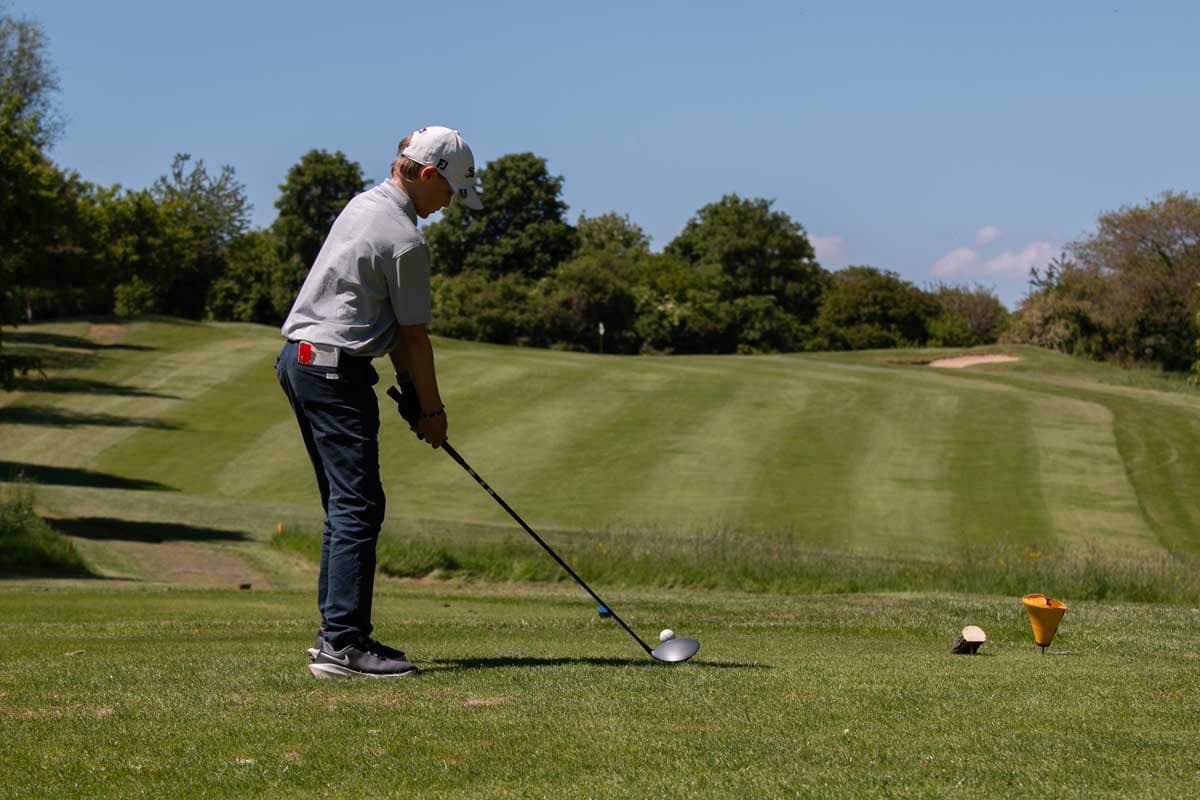
With Nikita, you can't tell from the next shot what happened on the last one. Whether he's just holed a chip from off the green or topped it clean over the green into the bunker, he just steps up to the next ball.
After one such botched chip, he once said to me, while I was caddying for him: 'Great, now I get to go play in the sand, and I know I've still got work to do on my chipping.' No frustration, no judgement. He takes the shot as it came. He putts the same way: he lets the ball roll into the hole instead of trying to force it in.
He didn't get this from a book. When Nikita was four or five, we arrived at the Baltic Sea in our motorhome after about eight hours on the motorway. I've watched a lot of children grow up in my family, and most of them would have sprinted straight to the beach to play in the sand. Nikita sat down quietly on the beach and watched the sunset, the way he knew it from Viktorija's daily meditation. And me? I wasn't there yet, back then, and I captured the moment on my phone.
Research backs up that enjoyment isn't a side issue. A review of 43 studies on children's and youth sport names lack of fun and social pressure, from parents, coaches or teammates, as key reasons why kids quit their sport. Kids already bring Wu Wei with them. Our job is mostly not to train it out of them.
What does it mean to go your own way in golf?
Going your own way means not chasing every tip, every number, every comparison, but sensing what fits your own game and your own child. That takes the pressure off.
In golf, it's easy to swim with the crowd. The next swing tip, the next Handicap number, the comparison with the other kids in the squad. We try not to get swept along by it.
We let Nikita develop as he is. There are guardrails, if things get dangerous or if he wants to do too much. But above all, we trust fully that he'll find his own way, wherever it leads. So after a round, the first thing we ask him is whether he enjoyed his game.
One example: many children and young players here in Saarland train and play using the Stack-and-Tilt method. We made a deliberate decision against it. I've written about why in a separate article. That's our decision, for our child, not a judgement of other families or coaches. Everyone has to work out for themselves what fits.
What does this calm look like off the golf course?
Off the course, this calm shows up in getting fully absorbed in whatever you're doing, and not letting the clock decide the moment. Kids often find that easier than their parents do.
Nikita's a natural at the piano, and it comes easily to him. He improvises and plays without sheet music most of the time. That's also his own way of getting ready for a tournament: in the morning he takes time at the piano, gets completely absorbed in it, and loses track of time.
That's where it gets hard for us parents. In golf, you've got to keep an eye on your tee time. When the clock's ticking loudly and Nikita's still playing, staying calm is hard for me. We're working on it.
Maybe that's the most honest line in this article. Our son lives Wu Wei at the piano just as much as on the green. I'm still practising it.
What stays with me from the prize ceremony
I didn't take a photo of Nikita's prize ceremony. And yet I can see that moment clearly: his look towards me, the gratitude in it, and the feeling that everything's fine, just as it is.
Our kids already know how to do this. They're in the moment, take a shot as it comes, and force nothing. We parents get to learn it from them again. Because if you go your own way, in golf as in life, you play calmer, freer, and in the end better, because you don't have to force anything.
If you like, try it at your child's next tournament, or on your own next round. Pick a single moment and live it fully: no goal, no phone, no question about the result. Just be there.
Maybe that's exactly when your child looks over at you.
Sources
- Diehl, K., Zauberman, G. & Barasch, A. (2016): How Taking Photos Increases Enjoyment of Experiences. Journal of Personality and Social Psychology — Taking photos can increase the enjoyment of positive experiences (9 experiments, over 2,000 participants) — https://psycnet.apa.org/record/2016-27715-001
- Barasch, A., Diehl, K., Silverman, J. & Zauberman, G. (2017): Photographic Memory. Psychological Science 28(3) — People who take photos remember more of what they saw and less of what they heard — https://doi.org/10.1177/0956797617694868
- Henkel, L. A. (2014): Point-and-Shoot Memories: The Influence of Taking Photos on Memory for a Museum Tour. Psychological Science — photographed exhibits were remembered worse than ones only viewed — https://doi.org/10.1177/0956797613504438
- Beilock, S. L. & Carr, T. H. (2001): On the fragility of skilled performance: What governs choking under pressure? Journal of Experimental Psychology: General 130(4), 701–725 — Pressure leads to step-by-step control of practised movements — https://doi.org/10.1037/0096-3445.130.4.701
- Crane, J. & Temple, V. (2015): A systematic review of dropout from organised sport among children and youth. European Physical Education Review 21(1), 114–131 — lack of fun and social pressure as reasons for quitting (43 studies) — https://doi.org/10.1177/1356336X14555294
- Zhuangzi, Chapter 19, Section 4: the archer (English translation James Legge; German rendering paraphrased) — https://ctext.org/zhuangzi/full-understanding-of-life
- Wikipedia: Wu wei — Definition 'deliberate non-action' — https://de.wikipedia.org/wiki/Wu_wei
- Slingerland, E. (2014): Trying Not to Try: The Art and Science of Spontaneity. Crown — Wu Wei and cognitive science (review) — https://ndpr.nd.edu/reviews/trying-not-to-try-the-art-and-science-of-spontaneity/
- Martin Kaymer interview, Golf Magazin (2019) — 'You have to let go of that urge for control' — https://golfmagazin.de/news/martin-kaymer-im-interview-ich-hatte-keine-ahnung-wie-gut-ich-war
- golfforum.eu, thread 'Mentaltraining' (2023) — one golfer's account (drafting a winner's speech in his head after a good start) — https://www.golfforum.eu/forum/thread/1317-mentaltraining/