Golf for children?
— What parents really want to know.
When Nikita tells other children, or their parents, that he plays golf, the same question comes back every time: "Golf — is that even something for kids?" The prejudices run deep, and they stop families from ever giving it a go.
We've been a golfing family for a long time. We know these questions, and we know the answers. That's why we're writing this: because the answers surprise most people.
The vast majority of clubs in Germany are glad to see children and families. Getting started costs less than most people think.
What you'll find here: honest answers to the questions parents ask when golf comes up as a sport. What it costs, how it starts, what your child needs — and what they don't. From our experience as a family, with the facts and figures we've researched.
If your child is curious about golf — or you're wondering whether it could be something for your family — you're in the right place.
Is golf really that elitist — and can you even get in?
No. Most golf clubs in Germany are actively looking for families and children — the cliché of the closed club doesn't hold any more.
Tell people your child plays golf and you get the looks first. "Golf, seriously?" You know the pictures: luxury cars in the car park, closed clubs, people giving you a sideways glance.
Nearly 80 per cent of German golf clubs take part in Abschlag Schule — a Deutscher Golf Verband (DGV) programme that has been aimed squarely at children with no exposure to golf since 1999. One condition of taking part: the children must not belong to a golf club at the start. The exact opposite of members only. Almost 9,000 schools and more than 200,000 children have had their first contact with golf through this programme (source: DGV service portal, Abschlag Schule).
In 2024 the Deutscher Golf Verband counted 686,708 members, of whom 42,247 were children and teenagers under 18 in DGV-organised clubs (source: DGV membership statistics 2024).
That doesn't mean the cliché came out of nowhere. Some clubs are stiffer than others. But the direction is clear: the door is open. And anyone who walks through it gets a friendly welcome at the vast majority of clubs — especially as a family with children.
Do I have to play golf myself?
No. You don't have to play, you don't need to know the rules, and you don't need to be able to swing a club. The coaching happens at the club.
What helps: showing interest. Asking questions. Having someone explain what the Platzreife is — the German course-permission certificate a player needs before going out on the course. But "able to play golf yourself" is nowhere on the list.
And what isn't yet, might still come. Maybe golf is a chance to try something together as a family. Golf has a built-in advantage: everyone plays their own ball, which means people of very different standards can play the sport together — for a lifetime. On the driving range or out on the course.
That's exactly how it works for us. We walk the course together, everyone plays to their own standard, and it makes no difference at all. Being outside together, sharing the game, enjoying the quiet — hardly any other sport offers that.
What does golf for children actually cost?
At recreational level, golf for children costs no more than football or swimming. Getting started is often free.
A lot of people think golf costs thousands a year. Here's the reality, step by step:
Taster session: free, or €5 to €20. The club lends you a set.
Membership: between €50 and around €300 a year for children, depending on the club — many clubs are under €150 (sample taken from German golf clubs; not an association average). Worth knowing: at many clubs a junior membership is free if one parent is a member, up to a certain age.
Coaching: often already included in the club fee. If it isn't, a small amount is added — around €100.
Equipment: trainers are enough to start. A second-hand half set of clubs costs from €100 to €150 (figures reported in golf forums). Clubs don't grow with the child — but other children grow too, and second-hand sets in the next size up often turn up at the club itself.
For comparison: children's sports like football or swimming sit in a similar price range to golf, depending on the club. Riding or judo can be considerably more expensive.
For families with little room to manoeuvre: the Bildungs- und Teilhabepaket (SGB II § 28 (7)), a German state scheme, reimburses up to €15 a month — €180 a year — towards club fees. At many clubs that covers a junior membership completely.
If a child eventually trains more seriously and plays tournaments, the costs go up — but that's true of every sport. More on that in our article on golf as a competitive sport.
How old does a child need to be to start golf?
From 4 with playful programmes, from 8 with the junior golf badges, from 14 with the official Platzreife.
Many clubs offer bambini coaching from the age of 4 to 6 (confirmed by GC Main-Taunus, Münchener GC and GC Jakobsberg among others). The youngest often start with SNAG — "Starting New At Golf" — a playful entry system and an official DGV partner. The SNAG clubs have a square grip that puts the hands in the right place by itself. The balls are the size of tennis balls and stick to the targets. Children roll, chip and throw. The philosophy behind it: play first, then learn, then practise. SNAG works from the age of 2 and is also used in schools.
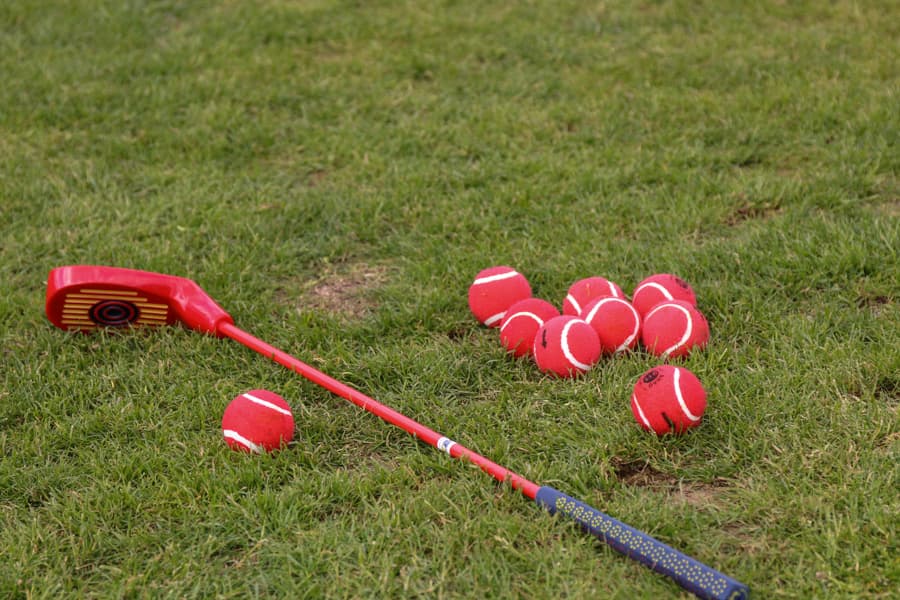
From around 8 it gets more concrete. Many children take the DGV Kindergolfabzeichen, the junior golf badge — bronze, silver, gold. More than 9,500 junior golf badges are awarded each year (source: DGV). The badges are taken during regular junior coaching — there's no separate course. There are 9 categories: putting, up and down, approach, bunker, long game, athletics, coordination, knowledge and playing experience. With the gold badge children get permission to go out on the course.
The regular DGV Platzreife is formally available from 14 — rules, etiquette and playing practice, not a performance test. But plenty of children play much earlier, either on the gold badge or on a club's own permission (each club decides for itself).
Coaching at recreational level means once or twice a week, an hour to an hour and a half each time. There's no separate "taster course for children" the way there is for adults — the child simply joins the regular junior sessions.
From taster session to Platzreife — how getting started works
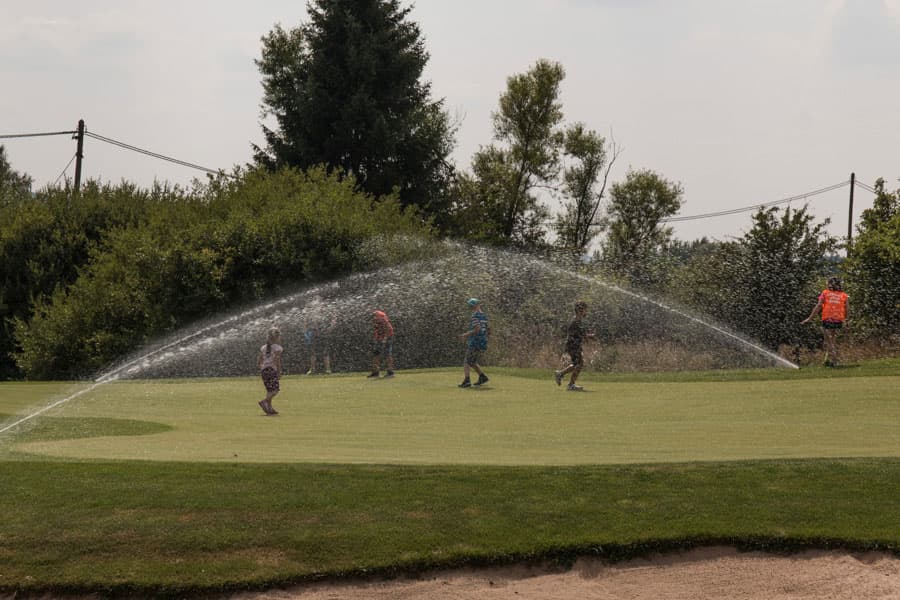
There are three usual routes into golf: through school, through the club, or through family and friends. They all lead to the same place — group coaching.
Route 1: through school. Abschlag Schule brings children to golf from year one — in the sports hall or on the golf course with SNAG equipment. Nearly 80 per cent of German golf clubs take part. The child needs to bring nothing, know nothing and pay nothing.
Route 2: straight to the club. Just ring up, make an appointment, turn up. Most clubs offer taster sessions free or for a small amount, and they lend you a set. If it's fun, the child moves into regular junior coaching.
Route 3: privately. Through grandparents, friends or neighbours who already play and simply take the child along. That's the first contact — the child then learns golf in junior coaching with the club's coach.
Whichever route: the next step is usually group coaching at the club, once a week. From there, at the child's own pace, comes the path through the junior golf badges and eventually to the Platzreife. Depending on the child and their age, that takes a few months to a few years. No pressure, no fixed timetable.
Important for parents: no child has to commit straight away. A taster session is exactly that — try it, see whether it fits, then decide.
What does my child need to get started?
For a taster session: nothing. The club lends you a set. If your child sticks with it, a second-hand half set and trainers are enough.
For a taster session your child needs exactly one thing: to fancy trying it. The club lends you a set, and that's it.
If the child trains regularly, a half set is enough — four or five clubs instead of the full fourteen. You'll find one second-hand from €100 to €150. Add a golf bag and possibly a trolley, so the child doesn't have to carry everything. Many clubs sell off their hire sets cheaply at the end of the season, and among golfing families at the club, clubs get passed on constantly because children outgrow them. Clubs will also often lend you a set if you haven't got your own yet.
Shoes: trainers are perfectly fine at the start. Golf shoes come at some point, but not on day one.
Dress code: depends on the club. Most are relaxed about children — polo shirt and long trousers or shorts, no jeans. Best to ask beforehand, then there are no surprises.
What you can skip at the beginning: expensive branded clubs — children grow too fast. And the urge to buy everything at once. The equipment grows with them, piece by piece. For practice on the driving range and the short course the club provides balls. Your child only needs their own once they're playing on the course — and for the first rounds, balls that have already seen a bit of flight are perfectly good. They cost a lot less than new ones.
How much time does golf cost the family?
At recreational level: one fixed session a week, everything else voluntary. No compulsory weekend training, and nobody minds if you miss one.
A typical golf week at recreational level looks like this: group coaching at the club once or twice a week, an hour to an hour and a half each time. That's the only fixed appointment. Beyond that the child can practise whenever they want — driving range, short course, putting green. As long as the club is open and it's light. Some children go three times a week after school, some once. The family decides that, not the club.
Compared with team sports it's relaxed: no second and third compulsory session, no league fixture every Saturday, and nobody minds if you miss one.
For parents that means, concretely: dropping off and picking up. Depending on how close the club is, that might be twenty minutes or an hour's drive. That's the real time factor — not the coaching, but the journey.
And weekends? There are tournaments for children that have nothing to do with competitive sport — simple formats, for fun and for the experience. If your child enters one, plan for the whole day: getting there, the tournament, the prize-giving, the pick-up. It's not compulsory, but it's a nice option. And if the whole family takes to golf, a day on the course becomes family time in the fresh air.
What happens when a child gets more ambitious and wants to put in more time? More on that in our article on golf as a competitive sport.
What does my child do besides training? Tournaments, camps and club life
Golf is more than hitting and practising. Around the club there are tournaments at every level, holiday camps, and a club life where children find friends.
Plenty goes on around the club — and that's exactly what makes the sport come alive for children.
There are tournaments at every level. One example from Saarland: there are three tournament series here for different age groups and standards. The Mini-Cup is aimed at the youngest — played from shortened tees over 9 holes. The Saar Trophy has been a team series for children up to about 12 since 2007: 9 holes, Stableford, with an adult marker accompanying each group. And the Jugendpokal runs alongside it for the older ones — AK 14, AK 16 and AK 18 (age groups), 18 holes, with gross and net scoring (source: Golfverband Saarland). In Rhineland-Palatinate the LGV Junior Trophy is a similar entry-level series.
Steps like these exist in every regional association. Nationally the DGV runs the GolfSixes League — a team series for children from 8 to 16, just 6 holes, played as a two-person scramble (always playing on from the better ball), and possible without a Platzreife (source: DGV service portal). Or the Lucky33 series: net scoring, open from a handicap of 45, with more than 700 children at 32 tournaments in 2024 (sponsored by Allianz). These aren't performance tournaments — they're tournaments where children pick up experience, meet other kids and have fun.
Holiday camps are offered by many clubs and golf schools — usually a week, with coaching, play and a programme around it. Prices range from €150 to €450, depending on the provider and the region.
And then there's club life itself. Junior teams, parent-and-child tournaments, club parties, simply being out on the course together. Golf is an individual sport — but at the club you're not on your own. Children find friends there who play the same sport. For a sport that's still barely known at school, that's not a given.
And if a child eventually finds they want more — training more often, better results, maybe a squad place — there's a path for that. More on it in our article on golf as a competitive sport.
Just give it a go
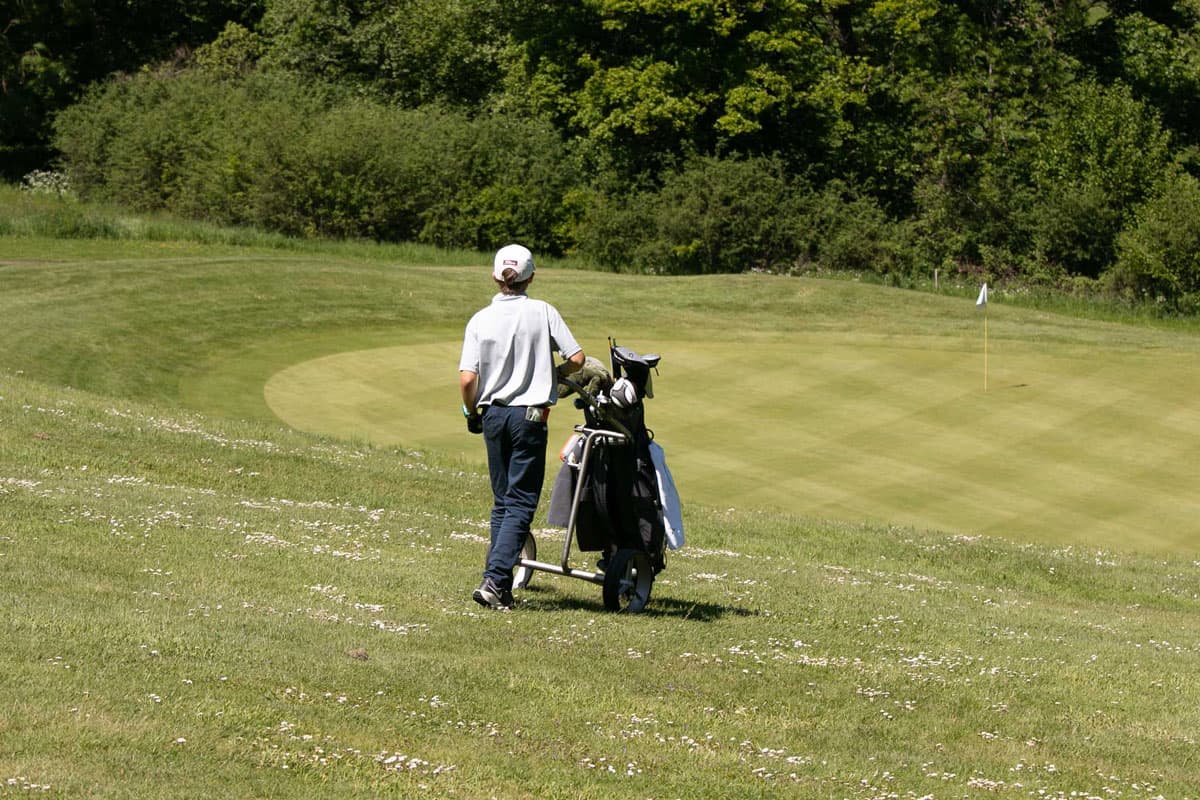
If you've read this far, you've probably noticed: golf is more accessible than its reputation suggests. The image that follows this sport doesn't match what waits for you and your child at the club.
Golf isn't as widespread as football — which is why a lot of families simply don't know that golf exists for children too, and that getting started is easier and cheaper than most people think.
If your child is curious — or you are — try it out. If your child comes back from that first taster session with their eyes lit up, you'll know whether it fits. Look at the website of a golf club near you; the junior coaching details are usually all there. Ring up or send an email and ask about a trial session. You don't need to know anything, be able to do anything, or buy anything.
And maybe, in the end, it becomes a sport for the whole family.
Sources
Association sources
- Deutscher Golf Verband — DGV membership statistics 2024: 686,708 members in total, 42,247 under 18 in DGV-organised clubs.
- Deutscher Golf Verband — Abschlag Schule: serviceportal.dgv-intranet.de/sport/schulgolf/abschlag-schule/
- Deutscher Golf Verband — Abschlag Schule, modules: serviceportal.dgv-intranet.de/sport/schulgolf/abschlag-schule/module.cfm
- Deutscher Golf Verband — Platzreife: from age 14, rules plus etiquette plus playing practice
- Deutscher Golf Verband — Kindergolfabzeichen: bronze/silver/gold from about age 8, more than 9,500 badges a year
- Deutscher Golf Verband — GolfSixes League: serviceportal.dgv-intranet.de/sport/nachwuchssport/GolfSixes_League.cfm
- Deutscher Golf Verband — scramble formats: serviceportal.dgv-intranet.de/spielbetrieb/wettspielvorbereitung/
- Golfverband Saarland — Jugend (Mini-Cup, Saar Trophy since 2007, Jugendpokal AK 14/16/18): golfverband-saarland.de/wp/?page_id=13
- Golfpark Bostalsee — Jugendteam (Saar Trophy detail: Stableford format, accompanied by a marker): golfpark-bostalsee.de/golfclub/mannschaften/jugendteam/
- LGV Rheinland-Pfalz/Saarland — Junior Trophy (entry-level series, shortened tees): lgv-rps.de/jugend/lgv-junior-trophy.html
- SGB II § 28 (7) — Bildungs- und Teilhabepaket: up to €15 a month towards club fees
Association-affiliated and providers
- Sample of junior fees at German golf clubs: €50–377 a year (club websites, not a representative average)
- Lucky33 tournament series (started by GC St. Leon-Rot, sponsored by Allianz): net format, 32 tournaments / more than 700 children (2024) — lucky33.de
- golfkids.fun — holiday golf camps: price range €150–450
- Holiday camp examples (range €150–540): GTHGC Hamburg, PGA Golf Akademie Würzburg, GolfRange Berlin-Großbeeren, Das Achental (Chiemsee)
- Bambini programmes confirmed from age 4: GC Main-Taunus, Münchener GC, GC Jakobsberg
Forum / reported experience
- golfforum.eu — second-hand junior half sets from €100–150