When golf starts to make sense for your child
– and what comes after
When parents look for a sport for their child, they work through a list. Football, swimming, gymnastics, tennis, maybe riding or judo. Golf rarely makes it onto that list. Hardly anyone thinks of it.
I notice it every time I mention that my son plays golf. Not at weekends for fun, but properly, with coaching and tournaments. Nobody argues. People are polite. There's a look. Friendly, questioning, a bit as if I'd just said the bumblebees in our garden say hello. Golf? A child? As a sport?
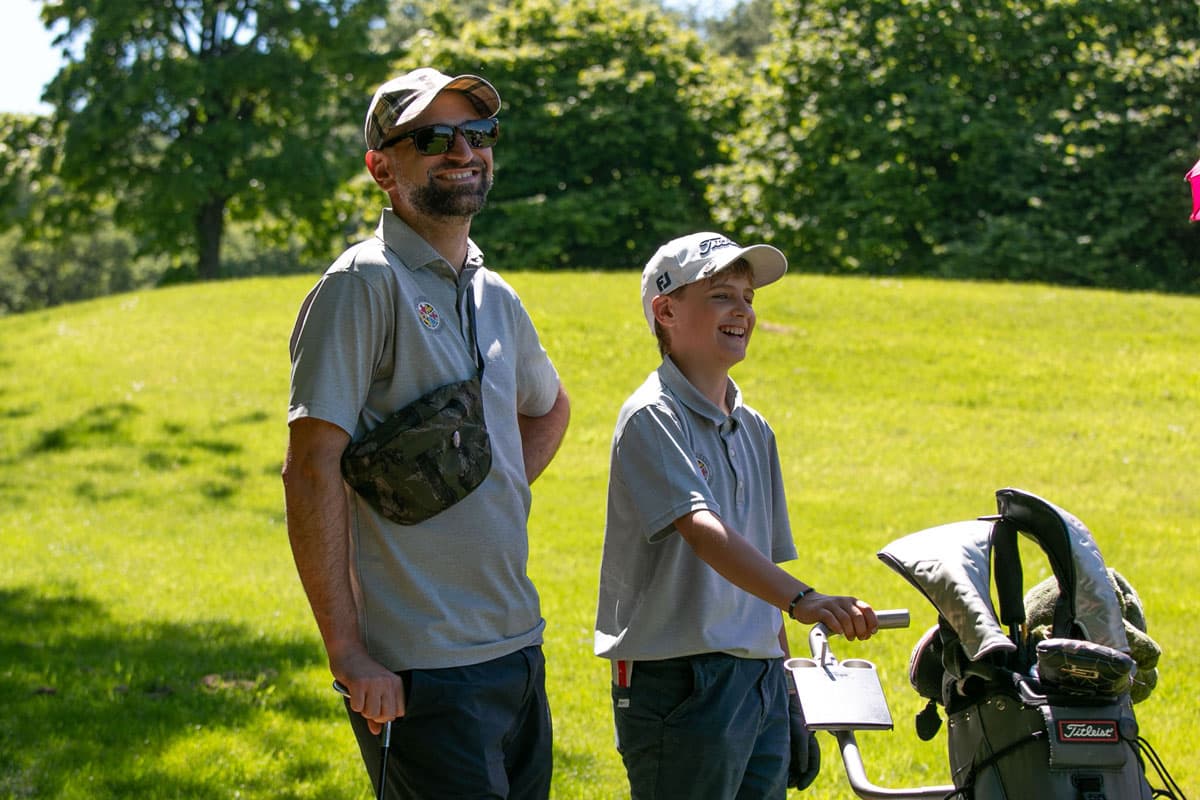
We've played for years ourselves, and my husband was junior coordinator and coach at the club. We never had to google these questions. But we've been answering them for years — at the edge of the course, at children's birthday parties, at parents' evenings.
Those answers are what's here. What age golf suits a child, how getting started works, and what's coming your way: equipment, money, time.
Maybe you're looking for something your child could try. Maybe you've brushed past golf somewhere and you're wondering whether it's for you. Then you're in the right place.
Why golf almost never comes up in the search for a sport
Most parents didn't rule golf out for their child. They never thought about it. And the reasons have little to do with the sport.
Other sports put themselves in front of you. The football pitch is in the village, the school has a team, the neighbour's child has played since nursery. Golf is missing from all of that. The course lies outside town, behind fields, behind a hedge. There's no school team and no child in the class who talks about it.
On top of that comes a picture everyone carries and nobody checks: older gentlemen, Sunday morning, expensive membership. Children playing golf doesn't fit into it.
On money, one distinction is worth making that almost never gets made. As a club sport, golf sits roughly where other coached sports sit. It gets expensive at the competitive level, and that's just as true of football or ice hockey. The figures are further down.
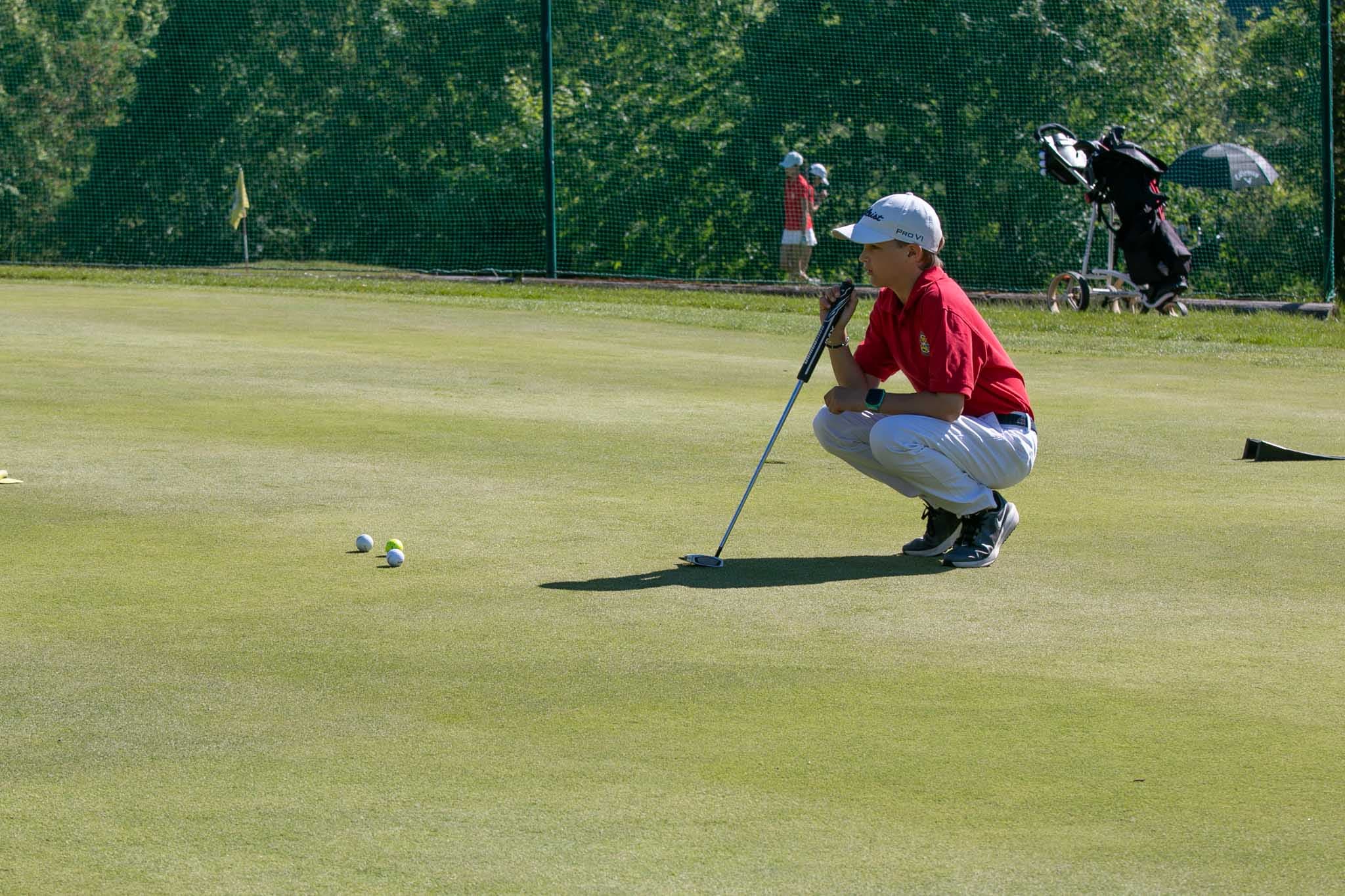
What children do in golf looks nothing like the word suggests: eight to thirteen kilometres on foot per round, in the open air, a movement that asks for the whole body, and concentration held over hours.
Which leaves the question most people arrive with: what age does this suit?
What age can my child start playing golf?
There's no minimum age, and no reason to start early. Most children begin between five and eight. What decides it isn't the date of birth, but whether your child can stay with one thing for a few minutes.
What gets coached at different ages varies a lot. A look at that shows why the age question matters less than it sounds.
Four to six
Some clubs take children from four in beginners' groups. It doesn't look like golf yet, and that's deliberate.
What's coached are the basics that count in any sport: balancing, throwing, catching, turning. In between the children play ball games or hockey. The club appears, but not as the main thing.
Many clubs work with SNAG Golf here — the name stands for "Starting New At Golf". Behind it sit oversized clubs, soft balls and targets with velcro surfaces the ball sticks to. It works on any field and in any sports hall. The point: a four-year-old hits the ball and sees a result straight away, instead of missing twenty times. Something to show for it from the first session, without a golf course.
On session length there's a usable rule of thumb: roughly two to five minutes of attention per year of age. A five-year-old will stay with something for ten to twenty-five minutes, if they're enjoying it. Good beginners' coaching therefore changes the task constantly.
Six to eight
This is where the usual start happens. A session lasts thirty to forty-five minutes.
Now the first real golf movements come in, mostly starting at the green and working outwards: putting, then short shots, then the full swing. Children play a lot at targets — who hits the hoop, who gets closest to the flag. The competition stays playful, and scores are rarely kept.
Groups are mixed, often sorted by ability rather than year of birth.
Eight to eleven
From here it starts to look like golf. Children now reliably understand rules and stick to them. It's no accident that the children's golf award is designed for exactly this span.
Twelve to fourteen
Anyone starting here catches up fast. Coordination and concentration are there, strength comes with them, and the movement can be explained directly instead of in pictures.
Coaching now means working on one thing, over weeks. Fitness work comes in too, where the club offers it. Children who've been at it longer play their first proper tournaments in this phase.
Why an early start doesn't decide anything
Golf is one of those sports where ability builds slowly. The road to a high level takes fifteen to twenty years. Whether it starts at six or at eleven makes little difference over that distance.
A research team around Arne Güllich analysed the careers of 6,096 athletes in 2022, among them 772 from the world elite. Those who made it to the top as adults had tried more sports as children, started their main sport later, and were slower than the competition early on. Those who specialised early won more junior tournaments — which said little about the level they reached later.
The often-quoted "golden age of learning" between seven and twelve is also disputed; sports scientists have doubted it since the eighties. It's a good time to learn, not a deadline.
What that means for the decision at home: this isn't about catching a train. It's about whether your child is ready — and whether they want to.
What to go by instead of the calendar
- The basic movements are there: running, jumping, throwing, catching
- Attention lasts for one session
- Safety rules are understood — that nobody stands in the swing area, for instance
- The interest comes from the child too, not only from you
Children of the same age can be years apart in development. A child who matures later isn't untalented. They're later.
Here's how it looked for us: Nikita started in the beginners' group at five and stopped again after a while. We both play golf, but he had no interest back then — and that was completely fine with us. He tried other things: swimming, fencing, riding, football, gymnastics, mountain biking. At eight he came back to golf on his own.
Studies to read up on: Güllich, Macnamara & Hambrick 2022 (journals.sagepub.com/doi/abs/10.1177/1745691620974772) · Baur 1988 on sensitive phases (link.springer.com/chapter/10.1007/978-3-642-93375-2_43)
How does my child start – and what comes after?
The route has four stages: try it once, train regularly, get permission to play the course, play first tournaments. Each stage is its own decision. Nobody has to commit to all of it at the start.
Most people look for a membership first. But that comes much later — and usually costs a lot less than it looks at first glance.
Stage 1 – Trying it
A taster session or taster course. Borrowed clubs, no membership, no contract. Trainers are fine, nobody needs golf clothing.
That's the whole first step: go once and look. Where you can do that is at the end of this article — there are more routes than the golf club.
Stage 2 – Staying with it
If your child wants to come back: weekly group coaching, usually an hour. The club organises it.
Groups are sorted by age or ability. Only here does the question of membership come up, and even that looks different for children than for adults.
Many children stay at this stage for years. Training once a week and enjoying it, without tournaments and without a handicap. That isn't getting stuck. That's the norm.
Stage 3 – Being allowed on the course
A child can't simply walk onto a golf course. They need permission — not as a hurdle, but because balls fly on a course and you have to know how to move around.
The route there is the DGV-Kindergolfabzeichen, the German children's golf award. Every child knows the principle from their swimming badge: there's a tag for the golf bag, and the stickers go on it one by one.
What the levels mean:
- Silver – at many clubs this lets the child onto the course, accompanied by an adult
- Gold – the top level. Many courses grant full permission to play with it
- From fourteen a young player can take the regular DGV Platzreife, the course qualification that also applies to adults
One thing matters here: who may play on their course, and when, is each course's own decision. The award is the nationally standard route there; the permission comes from the club.
Around 9,500 children take this award every year. It's the normal route, not a special case.
How long it takes depends on the child and the club. It runs alongside normal coaching, not as a course with a fixed date.
Stage 4 – Joining in
First children's tournaments, usually on shortened holes. Entry generally goes via the award in silver or gold.
What those tournaments look like is further down. For now just this: they have little to do with what you see on television.
What lies between the stages
Time. And neither pressure nor a deadline. A year can pass between stage 1 and stage 2. Between stage 2 and stage 3 as well. Some children stay at stage 2 and that's that — just as in any other sport, where not every child ends up in the team.
If you play golf yourself: your route was a different one. Adults have the Platzreife course, a compact package over a few days. For children it runs over months within ordinary coaching, with an award instead of an exam date.
The most common mistake in the order of things: buying equipment first, trying it second. It works the other way round, and that saves a few hundred euros if it doesn't stick.
Is the group enough, or does my child need one-to-one lessons?
The group is enough at the start. One-to-one lessons only become worthwhile once a child plays regularly and wants to work on something specific. They don't make anyone better faster.
Golf has a reputation here that comes from the adult world. Adults who start usually book one-to-one lessons with a golf coach — in golf you call them a "pro", short for professional. With children it works differently.
How children's coaching runs
One session a week with several children and one coach, through the season from spring to autumn. Some clubs offer indoor coaching in winter as well.
Coaching rarely means standing quietly side by side. There are stations with small tasks the children rotate through, and the coach watches each child individually.
Groups are sorted by age or ability, depending on how many children a club has. Unlike in team sports, a mixed group is no problem here: every child works on their own ball at their own pace. Nobody is held back, nobody drops out. Many children even prefer training with older ones who can already do more, because there's something to pick up.
The club organises most of it
That's the real relief, and it's rarely said out loud: as a parent, you don't have to put anything together.
At most clubs, children's coaching comes ready-made. There are fixed times, fixed groups, and a coach or junior coordinator in charge. You don't need to worry about one-to-one lessons at the start.
If a child wants more or can do more, there's usually a development group for that. Sessions are more frequent, groups are smaller, and the children work more individually with the pro. The club decides who joins.
Many clubs also have a supporters' association that helps fund children's coaching. For families that means part of the cost, which would otherwise land with the parents, is carried by the club.
And if a child really goes far, there are the regional federation squads above that. That's organised by the federation too, not by the family. More on that further down.
When a one-to-one lesson makes sense
In the first year or two, a child learns everything they need in the group, with other children around them. That's the real reason children stay.
A one-to-one lesson makes sense when three things come together: your child plays regularly, there's one specific thing that isn't working, and your child wants to work on it. Then a single lesson does more than ten in the group.
What it can't do is create motivation. A child who doesn't feel like it won't feel like it alone with the coach either.
On prices: a coaching hour costs between 45 and 80 euros depending on the course and the coach. In group coaching that's shared between several children and comes to a fraction of it.
What children practise in the first years
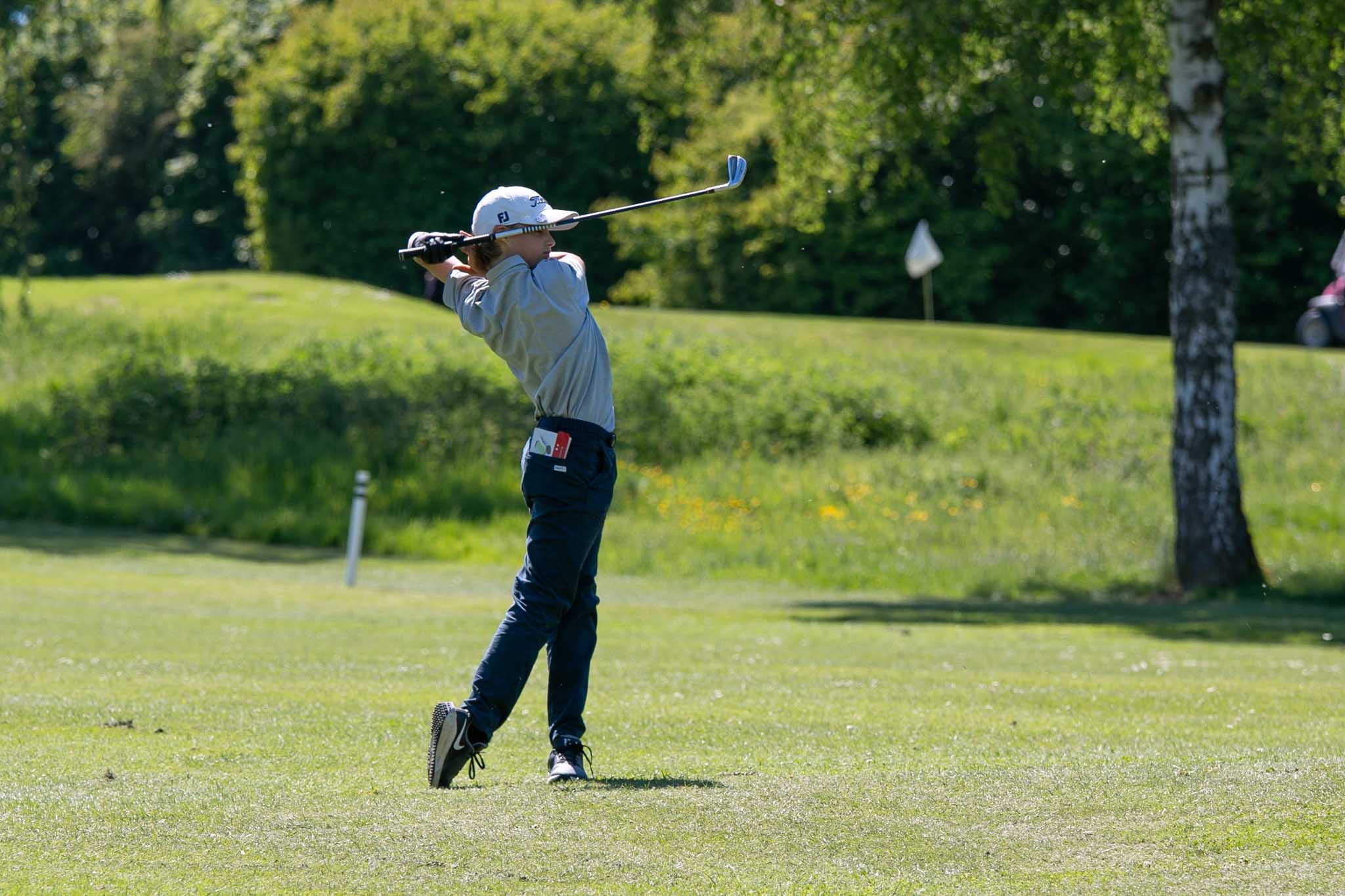
Technique isn't the focus at this age. Children still move without tensing up, and a good coach uses that: the swing grows playfully out of the natural movement, instead of being explained as a sequence of positions. The basics form along the way, and they carry a long distance later.
The children practise everything that belongs to the game. Shots over short and longer distances, the game around the green, putting, plus rules and conduct on the course. Mostly through targets, small tasks and competitions, so the children see a result.
Then there's the physical side: balance, coordination, turning. With the younger ones a session often looks more like gymnastics.
And golf has a side that's barely visible from outside. Children learn here to concentrate over hours, to keep playing after a bad shot, and to handle a result below their own expectations. The head belongs to this sport from the start.
What tournaments are there for children – and when does it become competitive sport?
The first children's tournaments are short rounds at your own club or a neighbouring one. They're about joining in and getting to know people. The score is secondary.
Tournament sounds like more than it is at the start. For the children it's mainly an afternoon with other children, often from clubs nearby. You meet the same faces again across a season, and friendships grow out of that which reach beyond your own club. Along the way a child faces a task they have to handle alone for the first time.
What a first children's tournament looks like
It's played like the grown-up version: the children start one after another in small groups, called a flight in golf. A flight is usually three or four players walking a round together.
At children's tournaments an adult goes with each flight. They keep the score and help with rules questions. That way the children learn the scoring and the rules along the way.
One example is the Mini Cup in Saarland. Nine holes from shortened tees, usually in the afternoon. The short holes are part of the format, so even the smallest players manage well.
A second format are the regional federation series, such as the Saar Trophy in Saarland or the GolfSixes League. There too an adult goes with each flight, and it's played over nine holes. Children can grow into these tournaments, move up an ability class and develop step by step.
Every federal state has its own series. What exists in your region is something the club's junior coordinator will know.
Qualifying or not – what the difference means
One term parents meet as soon as tournaments come up: whether a competition is qualifying.
Every golfer has a handicap — a number that reflects their playing level and falls as results improve. In qualifying competitions the result feeds into that number.
Beginner tournaments aren't qualifying. They're about enjoying it and gathering experience. That takes the pressure off everyone involved, parents at the edge of the course included.
What tournaments cost
At children's and junior tournaments run by clubs and regional federations, the entry fee is usually between ten and twenty euros. Often the club covers it, though not everywhere. Some clubs have a supporters' association for that.
Alongside them there are commercial tournament series whose entry fees start at a hundred euros and up, even for nine holes with the youngest players. They aren't necessary. The club and federation tournaments cover everything a child needs in the way of experience.
The travelling stays within limits too. Regional federation tournaments take place within your own state, usually easy to reach.
Where it gets more demanding
The German Golf Federation (DGV) runs the age-group tournaments. These are generally meant for children who play golf competitively. In some federal states they start at U12, in most at U14.
Alongside them run the regional federation squads. A child who gets in trains more often and travels to tournaments outside their own region. At that point golf becomes family planning, and the costs rise — less through entry fees than through travel and overnight stays.
Between the club afternoon and that level lie many intermediate steps. No child slips into competitive sport by accident.
Does my child have to play tournaments at all?
No. Many children train with their group for years and never play a single tournament. That isn't a missed connection.
How a tournament day runs from morning to evening, what parents may and may not do, and how the move into competitive sport works — we're writing a separate article on each.
What equipment does my child need?
Nothing of their own at the start. If your child stays with it, three or four clubs are enough. The right size depends on the child's height, not their year of birth. And buying second-hand works well here.
For trying it out and the first sessions, clubs lend equipment. Only when a child trains regularly is their own kit worth it.
Why height counts and not age
Three nine-year-olds can be different heights, and their clubs need to be different lengths to match. Makers like US Kids Golf therefore grade by centimetres and work with a sizing table. A set labelled UL-48 fits children between 122 and 130 centimetres, UL-57 for 145 to 152, UL-63 for 160 to 168.
You can measure at home. Your child stands upright against a door frame, wearing the shoes they play in. Put the height in centimetres into the table, done.
There's also a quick check for in between: stand the longest club upright in front of your child, grip on the floor. If it reaches roughly to the breastbone, the length is right.
The most common mistake is buying clubs to grow into. That works with shoes; it doesn't work here. A club that's too long forces the child into a posture that doesn't suit their body, and the movement adapts to it.
How many clubs a child needs
A full set of fourteen is unnecessary at the start. Three or four are enough: an iron, a wedge for the short game, a putter, plus a wood or hybrid. A beginner doesn't need a driver.
That's more than a way to save money. With few clubs a child learns to control the length of a shot through their own movement rather than through club selection. They notice how far an iron takes them with a shorter swing or a firmer grip. Anyone with a club for every distance never learns that. And the bag stays light enough for the child to carry it themselves.
Nikita played with his US Kids beginner set until his handicap was under twenty. Only then came a full, better set.
The growing-out problem
Children outgrow clubs, usually every one to two years. That's why hardly anyone buys new.
A second-hand junior set costs between about 25 and 200 euros on eBay or the classifieds, depending on condition. The same sets cost between 269 and 390 euros new. Buy second-hand and sell on after a year or two, and what you end up paying is modest.
The simplest route usually runs through the club itself. In every junior group the children are different ages, and what one outgrows fits the next.
There are also makers who solve the growing differently. Ping runs a programme called Get Golf Growing for its Prodi G line. Buy at least five clubs at once and you get one free adjustment: shafts extended, weights and grips swapped. After that it doesn't apply. That's a model for later, because Ping plays in a different price bracket and only pays off once a child is serious.
What else belongs to it
Not much. Trainers do the job for a long time; a child only needs proper golf shoes once they play on the course regularly. Weatherproof clothing matters more than golf clothing, because coaching happens in wind and light rain too.
A glove and a cap are quickly bought and worth having: the glove protects the hand, the cap the head and eyes. A rangefinder can wait. That sort of thing sits prominently in the golf shop and has little to do with learning.
What does golf really cost for a child?
As a club sport, golf costs a child roughly what tennis costs — more than football, less than ice hockey. It only gets expensive at the competitive level, and there golf stands out no more than other sports.
On costs you'll find everything and nothing online. Equipment lists without prices, fee schedules for adults, and the story of the expensive elite sport. So here are the figures along the four stages.
Stage 1: Trying it
Taster courses cost between nothing and 25 euros, borrowed clubs included. Some clubs charge nothing at all for a taster session. One phone call settles it.
Stage 2: Training regularly
The Bayerischer Golfverband writes itself that the annual fee for children under twelve rarely exceeds a hundred euros. Nationally, junior memberships usually run between fifty and two hundred euros a year, and at some clubs children's membership is free. Coaching fees of a similar order come on top, depending on the club.
Many clubs also have a supporters' association that covers part of it. Ask — it's rarely on the website.
For context: according to the sports development report by the German Sport University Cologne, half of all sports clubs in Germany charge children no more than four euros a month, so around fifty euros a year. Count the extras in, and football, gymnastics and swimming at club level usually stay under two hundred euros a year. Tennis runs at three hundred to six hundred. Ice hockey costs five hundred to a thousand in the first year alone, because the protective kit comes with it.
Golf sits in the middle of that field, roughly at tennis level.
The joining fee
The point that alarms parents most: several thousand euros as a joining fee or capital levy.
For children most clubs don't charge it, and where it does apply it's often deferred until the child moves to adult membership. By now more and more courses are dropping it for adults too.
Why a membership is needed at all
At one point you can't get around the club, and there's a practical reason for it.
Anyone playing tournaments needs a DGV card. You only get one through membership at a club affiliated to the German Golf Federation. That club is your home club and holds your handicap index. After every counting tournament the result lands there and is worked into it.
For the first years of coaching none of that matters. Anyone who only trains needs none of it.
Stages 3 and 4: Tournaments and extra coaching
Entry fees at club and regional federation tournaments are ten to twenty euros, and the club often covers them. Commercial series charge a multiple of that, sometimes over a hundred euros per tournament. They aren't necessary.
A one-to-one lesson with the pro costs 45 to 80 euros; in the first years a child doesn't need one.
It gets expensive once a child plays competitively: more tournaments, longer journeys, overnight stays, plus extra coaching depending on the route. Then you're quickly into four figures a year. In other sports the competitive level looks exactly the same.
For the vast majority of children the question doesn't arise. They train once a week, play the odd tournament at a neighbouring club, and stay right there. Those are the costs you have to reckon with.
If money is tight
Through the Bildungs- und Teilhabepaket — the German support scheme for education and participation — families on Bürgergeld, housing benefit, child supplement or income support can get fifteen euros a month towards club fees, up to a hundred and eighty euros a year. The application can be backdated up to twelve months.
For a children's membership at a golf club, that often covers the whole annual fee.
The honest summary
As a club sport, golf costs roughly what other coached club sports cost. Its reputation for being expensive comes from the adult game and from a time when joining fees were the rule.
What's expensive is competitive sport, and few children choose it.
How much time does golf cost the family?
In normal weeks it's one appointment, usually an hour. A tournament day, though, is half a day to a whole one — even at club level.
The normal week
Children's coaching runs once a week, through the season from spring to autumn. Reckon on an hour on site.
Then there's the drive. Golf courses lie outside town, often between fields and rarely within walking distance. If your child plays football, the pitch is usually in the village. With golf it's ten minutes or half an hour each way, depending where you live. That's the most honest factor in the time question, and it's worth working out before you sign up.
You don't have to stay during coaching. Many parents sit in the clubhouse or drive off again.
Winter carries on differently. Some clubs offer fitness sessions, others have an indoor facility. Ask at the club what the cold season looks like there.
When your child wants to go out alone
As long as a child only holds silver, they can't play the course on their own. They need an adult with them. If you don't play yourself, you'll usually find someone at the club.
Gold removes that. From then on your child can go out alone, and you drop them off and pick them up.
Holidays and camps
Many courses run camps in the school holidays, typically four days in a row, three to five hours a day. Some camps include overnight stays: at one club the children camp on the grounds, at another they sleep in a hotel right by the course.
For working parents that's a relief; for children it's often the moment the spark catches.
A tournament day, realistically
This is where parents most often underestimate the time. A nine-hole tournament sounds like two hours. The day looks different.
You drive there, at least an hour before the start. Your child picks up the scorecard, sorts out the formalities and warms up — hits some balls, goes to the putting green. Then the round itself, three to four hours depending on the field. Afterwards the prize-giving, and usually something to eat for the children.
Reckon on half a day, often a whole one. And that's for an ordinary club-level children's tournament, not the competitive circuit.
The travelling stays manageable. Club and regional federation tournaments take place within your own state, usually nearby.
An adult goes with the flight, keeps the score and helps with rules questions. That doesn't have to be you. At many clubs, team managers or other parents take turns.
When it becomes family planning
Once a child plays competitively, the arithmetic changes. Longer journeys come in, tournaments over several days, overnight stays. Whole weekends are taken, and siblings have to be organised around it.
That's a subject of its own, and it doesn't arrive suddenly. It builds over months, and you decide whether you go there.
Where can you start?
There are several doors, not only the golf club. Through school, through a taster course, through a holiday camp, or through a public course. Most cost little and commit you to nothing.
Through school: "Abschlag Schule"
This national schools golf programme has run since 1999 and is funded by the Vereinigung clubfreier Golfspieler, the association of club-free golfers. Nearly 9,000 schools have taken part so far, over 200,000 pupils, and almost eighty per cent of German golf clubs are involved. Between 600 and 700 projects are approved each year.
It was revised at the turn of 2026. Since then years 1 and 2 can take part as well; before that it started at year 3.
There are seven modules, from a single taster day at the course to twenty teaching units ending with the children's golf award and permission to play. A school can also simply borrow equipment and start in its own sports hall.
The interesting part for you: the school and the golf club apply together, two to twelve weeks before the project starts. At least eight children are needed, and the children must not already be members of a golf club.
In practice that means: an email to the PE teacher can be the beginning. Golf comes to the child, not the other way round.
Through the club: a taster session
The most common route. One session, borrowed clubs, no contract, usually between nothing and 25 euros.
Ring the club and ask about the next children's taster session. Many offers never make it onto the website.
Through the holidays: camps
Four days in a row work better for some children than four separate sessions. If your child needs time to warm up, this is the better way in.
Through a public course
There are several hundred public golf courses in Germany, and on many of them you can play without any prior experience. The driving range and the chipping and putting greens are open to everyone almost everywhere.
Which means: you can simply drive out, hire some balls and hit for half an hour. No booking, no club, nobody wanting anything from you.
How to find the right place
The quickest route is the club finder of the German Golf Federation. It shows you the courses near you and what junior provision they have.
Quicker still is to ring. Ask the office for the junior coordinator or the junior coaching. These four questions settle almost everything:
- What age do you take children from?
- Is there a taster session?
- Does my child need their own clubs?
- What does the first year cost?
If one club turns you down because the groups are full: that's a no from that one club. The next course is often twenty minutes further on and desperate for children.
How to tell on the first visit whether you're in the right place
Watch how your child is spoken to. Does the coach talk to them, or over their head to you? Are other children there? Does it feel relaxed?
If it doesn't feel right, try another course. Golf clubs differ, and the first one doesn't have to be the right one.
The question at the start was what age golf makes sense for a child. The more useful question is: how small can the first step be?
Very small. Go once, borrowed clubs, trainers. After that you decide further, stage by stage, and each of those stages is its own decision. Whether your child becomes a golfer isn't something you need to know today. Whether they go once, you do.
And if they've had enough after three months, that's not a lost year. Ours started at five, stopped after a while, and began again on his own at eight.
That you didn't know any of this isn't down to you. Nobody has put it all in one place.
What it looks like for an ordinary family is what Nikita shows on his YouTube channel: training, tournament days, bad shots included. Have a look if you like.
Two subjects we've only brushed here and are writing up separately: how a tournament day really runs, and how the move into competitive sport works.
Sources
- Güllich, Macnamara & Hambrick (2022): What Makes a Champion? Perspectives on Psychological Science. journals.sagepub.com/doi/abs/10.1177/1745691620974772
- Baur (1988): Sensible Phasen in der motorischen Entwicklung. link.springer.com/chapter/10.1007/978-3-642-93375-2_43
- Breuer & Feiler: Sportentwicklungsbericht für Deutschland 2020–2022, German Sport University Cologne
- Deutscher Golf Verband: children's golf award, GolfSixes League, Abschlag Schule. serviceportal.dgv-intranet.de
- Abschlag Schule, application conditions. abschlagschule.golf.de
- Bayerischer Golfverband: junior development
- Vereinigung clubfreier Golfspieler: public golf courses. vcg.de
- US Kids Golf: fitting table. uskidsgolf.com/fitting
- Bundesministerium für Arbeit und Soziales: Bildungs- und Teilhabepaket
- Ping: Get Golf Growing programme, Prodi G Junior. golfimport.ch / golfbrothers.de
- DGV service portal: children's golf award handbook (PDF)