Stack and Tilt
— and your child's spine.
You've come across Stack and Tilt — on YouTube, at the club, maybe through a coach. Cleaner ball contact, fewer fat shots, more consistency with irons: sounds good. So now the question — could this work for your child?
Short answer: Opinions are divided. The inventors say Stack and Tilt is easy on the back. Critics say the movement puts the spine into positions identified in sports medicine as a risk factor for stress fractures in young athletes. A measurement study to settle this doesn't exist yet. Until it does, we go with the precautionary principle — and train differently.
I'm Dieter, Nikita's father — and I've been looking closely at what does and doesn't work for a young body on the golf course. Here's what I've learnt.
What does Stack and Tilt promise — and does it deliver?
Stack and Tilt promises more consistent ball contact because the weight stays on the front leg. With irons, that holds up — golfers worldwide report fewer fat shots and straighter ball flight.
The idea: if the body stays over the ball, the club hits the ground at the same spot every time. In golf forums, it sounds like this: "Clean iron shots — but the driver? Disaster."
The real strengths
- Clean strike — club hits ball before ground
- Fewer fat shots and topped irons
- Straighter ball flight, less slice
- Repeatable movement
These strengths are documented. The price might be paid in the body — and that's exactly where opinions split.
What happens to the back with Stack and Tilt?
There are two camps on what it does to the spine. Both argue biomechanically — but neither side has a measurement study. Here are the positions, so you can form your own view.
What the inventors say
Mike Bennett told Golf Digest (2007): "Not one player has complained to us about back pain. Many say their back feels better." Orthopaedic surgeon Dr. H. Morton Bertram III confirmed in the same publication that the forward hip movement in S&T could reduce rotational load. Supporters also argue that S&T eliminates the reverse pivot — a movement long identified as a swing fault and a source of back strain.
What critics say
In the same Golf Digest article, one reader noted: "Stack and Tilt demands enormous flexibility. Without that flexibility — especially in the mid-back — the swing creates significant shear forces in the lumbar spine. And shear force is the most destructive force the lumbar spine has to withstand." The Titleist Performance Institute (TPI) — the world's leading authority on golf fitness — has identified the so-called Reverse Spine Angle as one of the main causes of back pain in golfers. Whether Stack and Tilt creates or actually prevents a Reverse Spine Angle is the heart of the debate — and it hasn't been resolved by a measurement study.
Why this matters for children
Even if you don't know which side is right — in an adult with a fully developed skeleton and a trained core, the risk may be manageable. In a growing child, the margin for error is smaller. That's what the next section is about.
Why is a child's spine especially vulnerable?
Setting the Stack and Tilt debate aside: a child's spine is more susceptible to certain loads than an adult's. That's not an opinion — it's sports medicine.
The technical term: spondylolysis
A stress fracture in the pars interarticularis — the thinnest part of the vertebral arch, the point connecting the upper and lower joints of a vertebra. In children and adolescents, this bone hasn't fully hardened yet. A case study in the International Journal of Sports Physical Therapy (Brearley et al., 2021) found that the pars interarticularis is a structural weak point in young athletes — skeletal immaturity is one of the biggest risk factors.
In the worst case, this leads to spondylolisthesis — a vertebra slipping forward over the one below it.
The trigger mechanism
Repeated hyperextension of the lumbar spine, especially combined with rotation. This is well established in sports medicine and not contested. Sports with high spondylolysis rates in young athletes — according to Physiopedia and Sport Med School — include gymnastics, American football, cricket, wrestling, weightlifting, dance and baseball, all of which involve repeated hyperextension and rotation.
The numbers from research
A narrative review (PMC, 2026) reports spondylolysis rates of up to 41.7 per cent in young athletes presenting with back pain. The same source puts the general population rate at 3 to 10 per cent. A study of young elite golfers (aged 16–30, median around 20) found that 41 per cent developed lower back pain within six months — a sign that golf in general places a load on the lower back, not just specific swing styles.
Why young bodies take a harder hit
Soft bone. The skeleton is still under construction. Growth plates — areas where bone is still more like cartilage than finished bone — and vertebral arches are still deformable. What a trained adult's muscles absorb hits a child's bone directly.
Muscles can't keep up. During puberty, the body grows in spurts — faster than the muscles can follow. The core can't buffer shear forces adequately. The load goes to discs, bone and joints.
Hundreds of repetitions a week. On the range, in training, on the course: every swing that puts the lumbar spine into hyperextension and rotation adds up. In soft vertebral arches, that's a risk.
The long-term consequences can be serious: sustained incorrect loading during growth can lead to chronic pain, early wear in the facet joints, and disc damage — problems a young golfer may carry for the rest of their life.
What does that have to do with Stack and Tilt?
This is the key point — and here we're honest about what we know and what we don't.
What is established: Repeated hyperextension plus rotation of the lumbar spine is the main trigger for spondylolysis in young athletes. That's consensus in sports medicine.
What is contested: Whether Stack and Tilt produces that load or not. The inventors say no — on the contrary, S&T stabilises the spine. Critics say: the movement's logic suggests the swing creates significant shear forces in the lumbar spine without sufficient flexibility.
What's missing: A biomechanical measurement study that objectively measures spinal load in Stack and Tilt. That study doesn't exist — not for adults, and certainly not for children.
Our position as a family
Until that study exists, we take the cautious route. For an adult golfer with a finished skeleton and a trained core, the risk may be manageable. For a growing child — with soft vertebral arches, an immature musculature and hundreds of swings a week — the margin for error is too small for us. If it turns out S&T is harmless, we've lost nothing. If it's not, we've protected our child's back.
The often-quoted anecdote that "9 out of 13 clinic participants developed back problems" comes from Chuck Quinton — the founder of Rotary Swing, a direct competitor. That number has never been independently verified. Our caution isn't based on a competitor's claims. It's based on what sports medicine says about young spines.
How do children learn a healthy golf swing today?
What we look for in a good junior coach is a neutral spine and natural weight shift — not a fixed weight on one leg. That way the swing grows with the body.
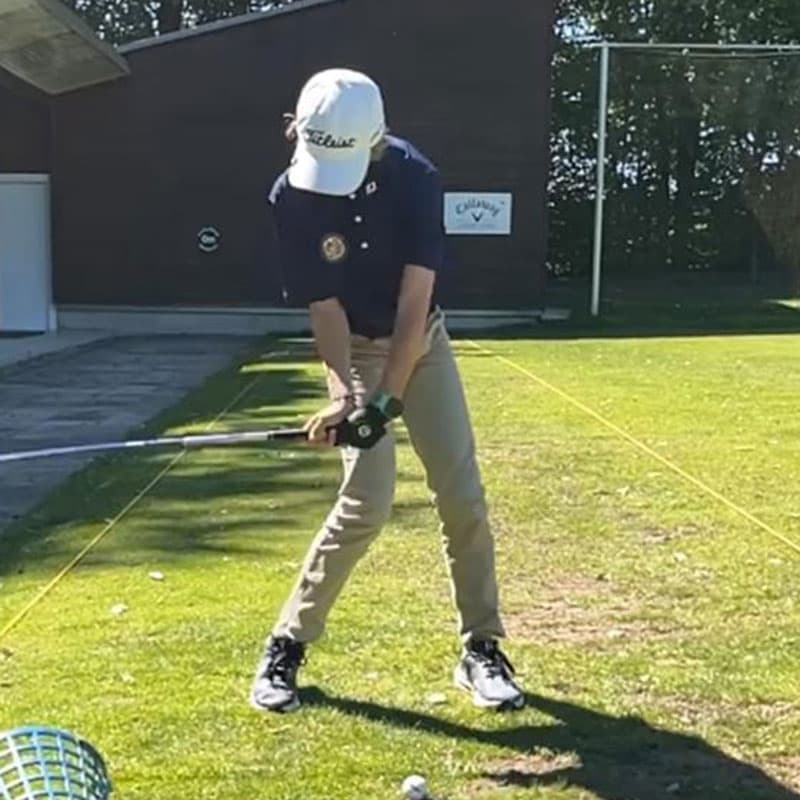
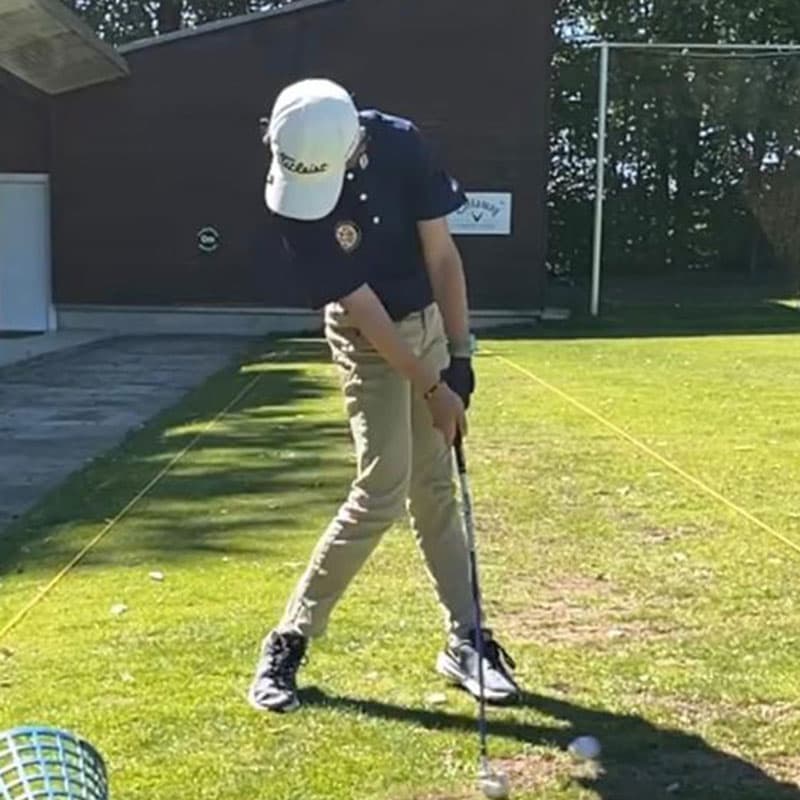
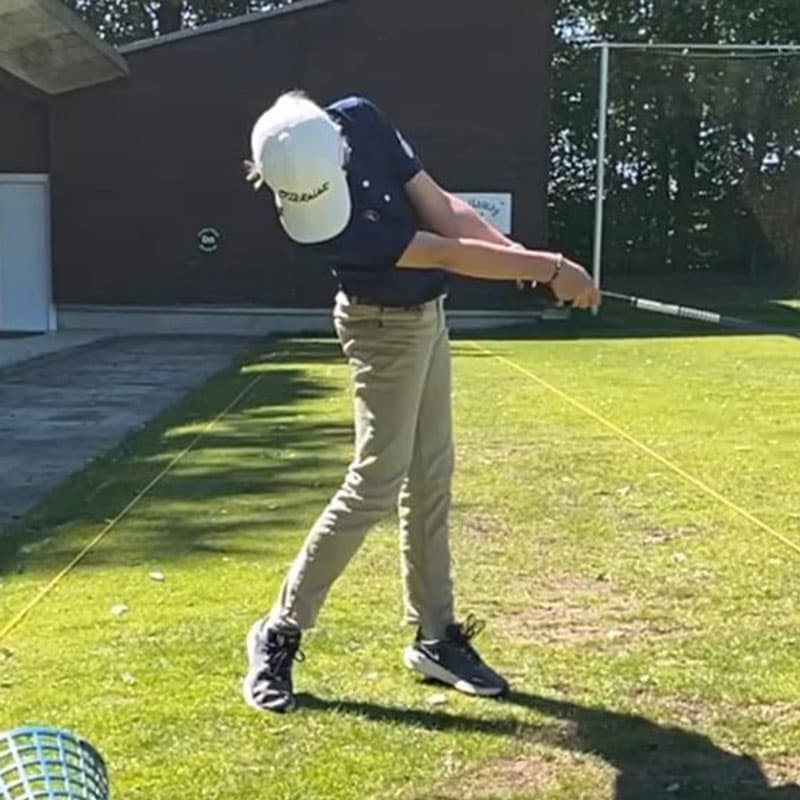
That doesn't mean your child has to give up clean ball contact. Clean striking is the goal of every swing. The path there just doesn't have to run through a technique whose effect on growing spines hasn't been resolved.
Three questions to ask the coach
These are the questions we ask ourselves as parents — and you can ask them too when you're looking for a coach for your child:
Does he ask about growth? A 10-year-old in the middle of a growth spurt needs a different swing than a 16-year-old with a nearly finished skeleton. If the coach teaches every child the same thing — whether they're 8 or 16 — that's a warning sign.
Does he build core strength before technique? Before a child learns swing technique, they need stability in the core — so the muscles can absorb the forces the swing creates. A good coach builds that in.
Is the child free to move? Children learn best in motion, not fixed positions. A swing that lets the weight shift rather than locking it down protects the back. And it's more fun.
One more note from research: A randomised study with 45 junior golfers (PMC, 2025) looked at whether a targeted warm-up programme reduces back pain. The results were encouraging, though not statistically significant across all endpoints. Still: ask whether your child warms up before hitting the range — it certainly doesn't hurt.
Will my child lose distance without Stack and Tilt?
No. In my experience as a coach, distance in children comes from clean contact and good timing — not extreme body positions.
A child who strikes the ball in the centre of the face hits it further than one who swings hard but makes poor contact. Distance comes with growth — if the swing is right.
Can my child take individual Stack and Tilt elements on board?
Yes — and that's exactly what many experienced golfers do.
Individual ideas can be built into a healthy swing: more focus on the front leg, for example, or more deliberate shoulder tilt. What matters: the overall movement must not force the spine into repeated hyperextension and rotation. Which elements fit is something a coach who knows your child's physical development should decide.
Where do I find a good junior golf coach?
A complete DACH coach directory doesn't exist yet — we're working on it.
In the meantime: ask your club specifically for a coach with junior experience. And ask one direct question: "Do you factor my child's physical development into your coaching plan?" The answer will tell you more than any certificate.
Our conclusion
Stack and Tilt has real strengths for adult golfers — cleaner ball contact, more consistency with irons. That's not in question here. And for adults with good training, the concern about the back may turn out to be unfounded.
For growing children, we see it differently. The debate over whether Stack and Tilt loads or protects the spine is open. What isn't open: young spines are more vulnerable than adult spines. And until someone has shown that S&T is safe for growing vertebral arches, we train differently.
What I've learnt as a father and coach: clean ball contact is achievable without unresolved risk. With a swing that protects the spine, leaves movement free — and grows with the body. Nikita Schummer trains that way. And his back is the better for it.
Want to see what that looks like? Check out our training videos — or join the next challenge. Golf is the finest sport there is. Your child's back should still think so years from now.
Golf. My sport. Join in.
Note: This article is not a substitute for medical advice. If your child has specific complaints or you suspect an injury, please consult your paediatrician, orthopaedic surgeon or sports medicine doctor.
Sources
Peer-reviewed studies:
- Brearley SL, Buckley O, Gillham P, Clements B, Coughlan D — Inter-Disciplinary Conservative Management of Bilateral Non-United Lumbar Pars Defects in a Junior Elite Golfer. International Journal of Sports Physical Therapy, 2021, 16(1):236-247.
- PMC — Spondylolysis: A Narrative Review of Etiology, Diagnosis, and Management. 2026. Narrative review; spondylolysis prevalence in young athletes presenting with back pain: up to 41.7%. pmc.ncbi.nlm.nih.gov/articles/PMC12940356
- PMC — The Efficacy of Injury Screening for Lower Back Pain in Elite Golfers. 2023. Prospective cohort study; participants aged 16–30. pmc.ncbi.nlm.nih.gov/articles/PMC9982516
- PMC — Warm-Up Program for Adolescent Golfers and Low Back Pain. 2025. Randomised controlled trial; 45 participants. pmc.ncbi.nlm.nih.gov/articles/PMC12358233
- PMC — Rehabilitation Considerations for Spondylolysis in the Youth Athlete. 2020. Klinischer Kommentar. pmc.ncbi.nlm.nih.gov/articles/PMC7134351
- Gross PW, Yang M, Jones RH, Doyle SM — Return to Sports Following Spondylolysis Surgery in Children and Adolescents: A Systematic Review. 2024. journals.sagepub.com/doi/10.1177/15563316241234843
Institutional sources:
- Titleist Performance Institute (TPI) — Reverse Spine Angle: Swing Characteristics. mytpi.com/improve-my-game/swing-characteristics/reverse-spine-angle
- Titleist Performance Institute (TPI) — The Golfer's Guide to Lower Back Pain – Part 1. Datengrundlage: 31.000 Golfer, 28,1% mit Rückenschmerzen nach jeder Runde. mytpi.com/articles/health/the-golfer's-guide-to-lower-back-pain-part-1
- Physiopedia — Spondylolysis in Young Athletes. physio-pedia.com/Spondylolysis_in_Young_Athletes
- Sport Med School — Spondylolysis. sportmedschool.com/spondylolysis
Cited opinions (pro-S&T):
- Golf Digest — A Stack & Tilt Back. August 2007. Aussagen von Mike Bennett + Leser-Kommentar zur Flexibilität. golfdigest.com/story/a-stack-tilt-back
- Golf Digest — Stack & Tilt: Medical Issues. August 2007. Dr. H. Morton Bertram III, Orthopäde, Naples FL. golfdigest.com/story/stack-tilt-medical-issues